
A needle holder grips the suture needle so the surgeon can pass it through tissue with control. The right pattern depends on the size of the needle, the tissue and the type of surgery. Here are the most common patterns and what sets them apart.
Parts of a needle holder
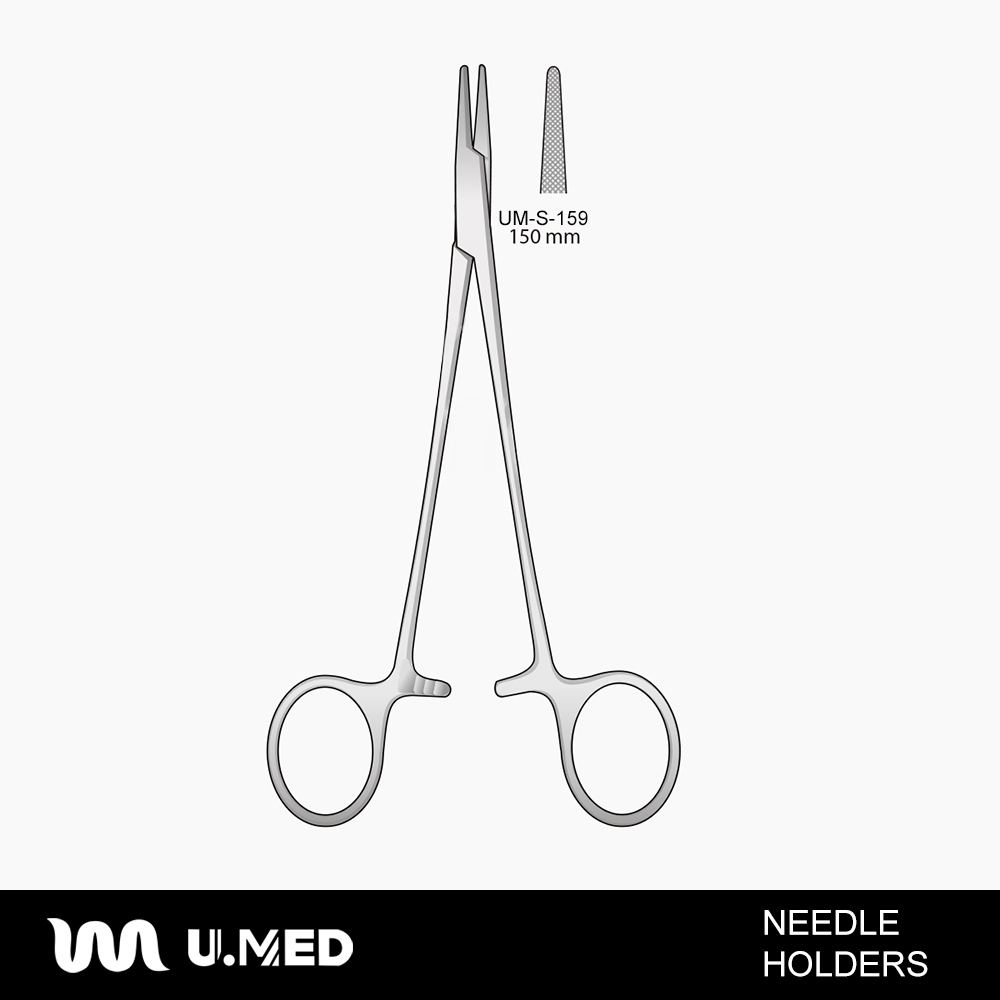
- Jaws: short and strong, with a cross-serrated or smooth gripping surface
- Box joint: the pivot that keeps the jaws aligned
- Ratchet: locks the jaws on the needle, usually in three steps, so the surgeon does not have to keep squeezing
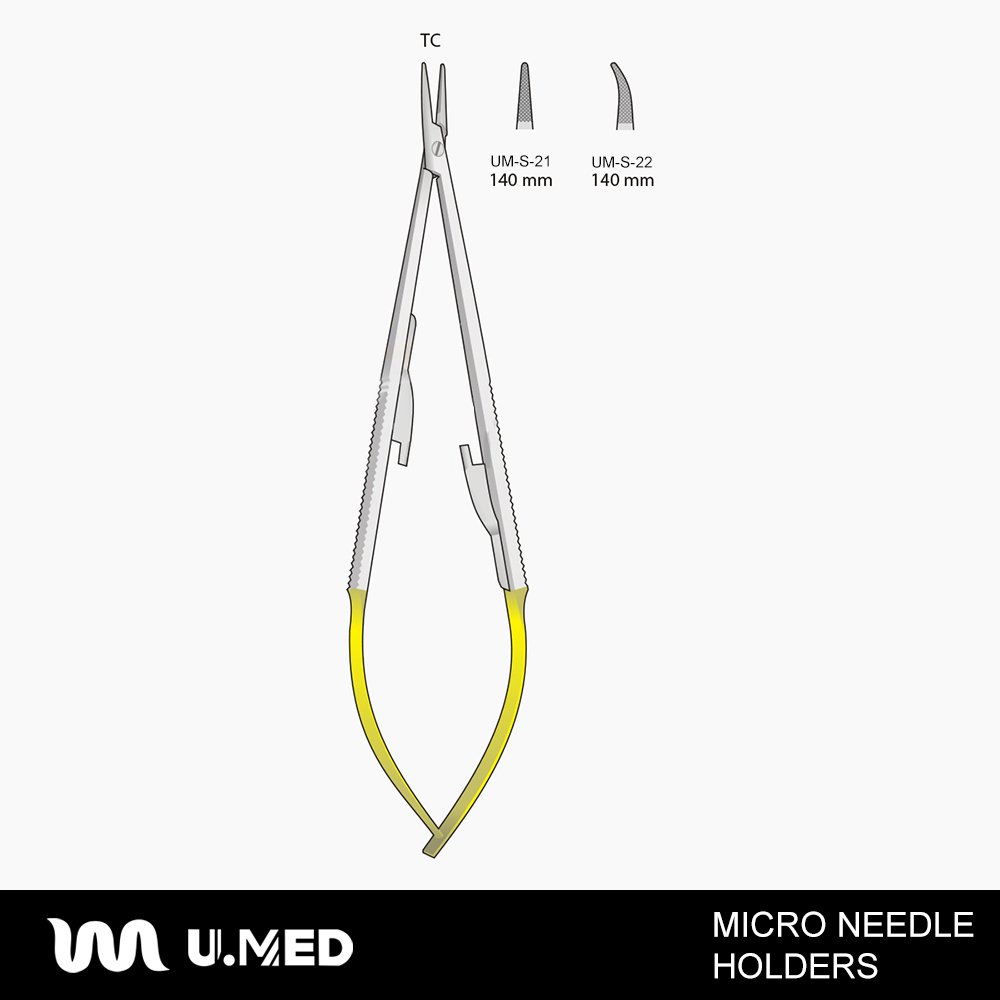
- Handles: finger rings on most patterns; spring handles on micro patterns
Common patterns
| Pattern | Main features | Typical use |
|---|---|---|
| Mayo-Hegar | Strong, broad jaws, ring handles, ratchet | General surgery; the most widely used pattern |
| Olsen-Hegar | Needle holder and suture scissors in one | Minor surgery and skin closure, when working alone |
| Halsey | Small, fine jaws | Fine sutures, plastic and minor surgery |
| Derf | Short, small instrument with narrow jaws | Fine skin sutures and small wounds |
| Castroviejo | Spring handle, very fine jaws, often with a lock | Micro, ophthalmic and plastic surgery |
| Jacobson | Micro needle holder with spring handle | Microvascular and micro surgery |
Standard jaws vs tungsten carbide jaws
Standard needle holders have jaws machined into the stainless steel. Tungsten carbide (TC) needle holders have hard carbide inserts in the jaws. TC jaws grip the needle more securely, resist wear far longer and, on many designs, the inserts can be replaced. TC instruments usually have gold-coloured handles so staff can recognise them.
Matching jaw serration to needle size
- Coarse cross-serration: larger needles and heavier sutures
- Fine serration: medium and fine needles
- Smooth jaws: very fine micro sutures, where serrations could damage the needle or thread
What to check when buying
- The jaws close evenly along their full length with no gap
- The ratchet engages and releases cleanly on every step
- The box joint moves smoothly with no side play
- The needle does not rotate when locked in the jaws
- The instrument is marked with the maker and pattern, and is CE marked
Needle holders from U.Med Instruments Co.
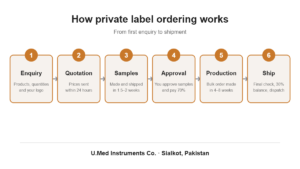
U.Med Instruments Co. manufactures reusable surgical, dental and hospital instruments in surgical-grade stainless steel, in our ISO 9001 and ISO 13485 certified factory in Sialkot, Pakistan. Our products carry CE marking, and we supply distributors, clinics and medical brands in the USA, UK, Europe, the Middle East and South America. Private label is available, and the MOQ is 500 pieces per order, mixed across products.
Browse the range or ask for a quote on WhatsApp +92 301 8111268 or at info@umedinstruments.com.



Leave a reply